Artificial intelligence (AI) is inescapable at the moment. Here’s a succinct summary of how I do and don’t use it at DNA Painter.
Before I dive in, I’m not intending to pass judgement on anyone else and how they use AI. Just as with anything else in life, everyone has their own taste!
AI on the website
DNA Painter itself does not currently use AI at all in its visualisations or analysis. I’m open to using it in future so long as I can retain data privacy and there are clear benefits to users.
Writing
More and more, I find myself sighing when I encounter giveaway AI phrases in blog posts. To write in any voice other than my own would feel dishonest, inauthentic and just weird to me. However, I’m also very keen to improve my articles where possible. So long as I don’t ask it to do any actual writing, AI can be very helpful with this. I’m very grateful for its assistance as a sounding board. My process at the moment:
- I work articles up as I’ve always done, either directly in the blog or in a word processor
- I then often paste the finished article into a chatbot prompt asking for comments
- The chatbot is able to flag areas that are unclear as well as suggesting any obvious omissions
- I read and assess this advice and make edits and additions as appropriate
- I repeat the process until it feels ready to publish
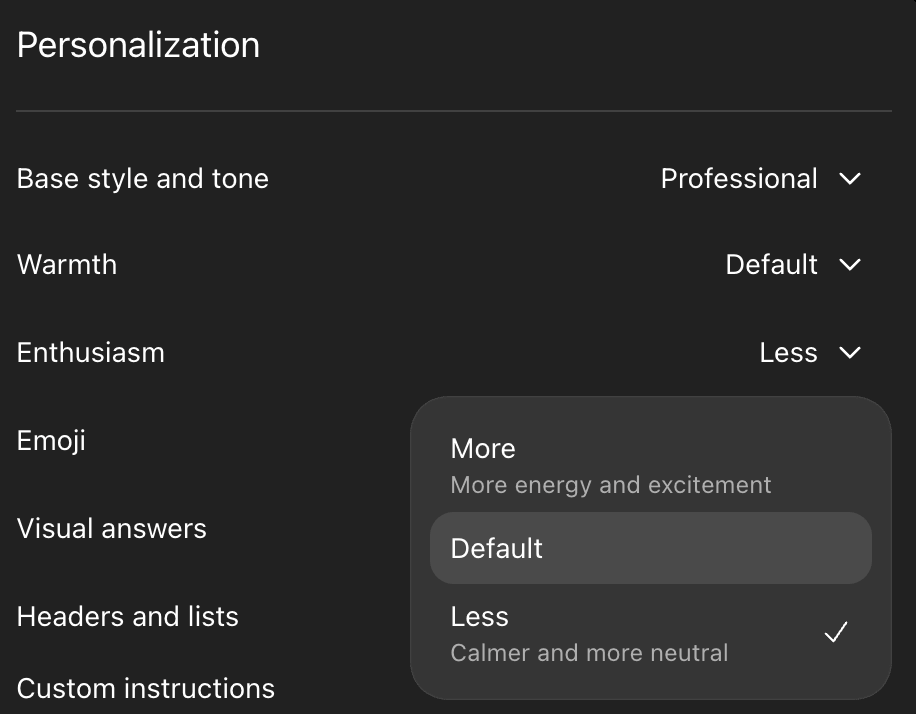
At the moment I use ChatGPT for this. Since I lowered the enthusiasm setting in Personalisation, I’ve enjoyed the less effuse and more neutral nature of responses.
I’m confident that at the end of the process, the article is better than it would otherwise have been. Most importantly, it also remains authentically ‘me.’
Images
Having dabbled quite a bit in 2022, I don’t tend to use AI for images much. While I’m aware that careful and tasteful use can produce amazing results, the types of article I write are generally better served by screenshots or photographs. And yes, I’m a bit tired of seeing generic AI promotional images!
Beyond DNA Painter, my main concern is one shared by many: that AI-generated images that are not identified as such will pollute the historical record. This isn’t to say that AI-generated historical images can’t be interesting. I saw Laurie Anderson perform recently and there was a fascinating sequence in which she took family stories that were in themselves fantastical, and used AI to visualize them.
Programming
This is the big one. When it comes to AI, I have the same conflicted feeling as a lot of programmers:
- I can learn a vast amount and also accomplish tasks much more efficiently if I use AI to assist me
- At the same time, the site is my personal creation and I don’t want there to be any code that I don’t understand
When considering how to use AI as a developer, I’m still working out the best process for me:
- If I have a new task or bug to fix, I will generally go into the code and work on it as I’ve always done
- But when the best way to proceed is not obvious to me, it feels more efficient to write a short prompt explaining what I want to do, and have AI walk me through any code and database changes needed
- I currently do this within a chatbot, copying and pasting excerpts without giving it access to the full codebase
- In order to preserve the site’s branding and avoid a generic look and feel, I don’t tend to use AI for design or styling
- For server updates, security, and code audits, AI is an indispensable companion
Overall, this means I can be more responsive to requests and release new features more efficiently. For example, I was able to take the Matrix tool from idea to reality very quickly.
We’re now living in what for me is a strange new world in which the technical barrier to building web applications is now very low. I hope more and more people who are using AI in creative ways for genealogy are able to create apps or share repeatable workflows. That way, others can benefit without having to work out the process themselves.
Other possible uses for AI at DNA Painter
I’ve had many discussions with colleagues and peers about how AI could potentially be used to facilitate DNA research. I feel as if there are a few factors slowing things down:
- Privacy: we should never share identifiable match information with a chatbot but there may be ways to anonymise it that mean it can then be used
- Access: the most useful DNA match information is held on protected systems where extracting this data is difficult
- Reliability: the last thing we want is for users seeking help to be given incorrect information, and AI hallucinations still exist
The testing sites themselves have access to shared match information, so are better positioned to explore the possibilities, and I wonder if we’ll start to see AI being used in match analysis in future.
Perhaps the most likely use of AI at DNA Painter would be to explain how to use the tools and potentially interpret results. For example, a chatbot may be able to look at an anonymised What are the Odds? (WATO) tree and offer some guidance as to next steps.
Going back several years, I did create a DNA Painter custom GPT. At that point, it was clear to me that this DNA Painter-specific chatbot had the potential to be more of a liability than an asset. For example, it didn’t understand at first that the site did not use raw DNA data!
While writing this article, I migrated the custom GPT to a plugin as an experiment, and my initial tests indicate that it is already far better than the early iteration. The plugin was able to offer succinct, accurate advice on how to map your chromosomes and on the data you need in order to use WATO. I may explore making something similar available publicly in future.
Thank you for reading and for your support for DNA Painter. If you have any suggestions or feedback please let me know.
Contact info: @dnapainter.bsky.social / jonny@dnapainter.com