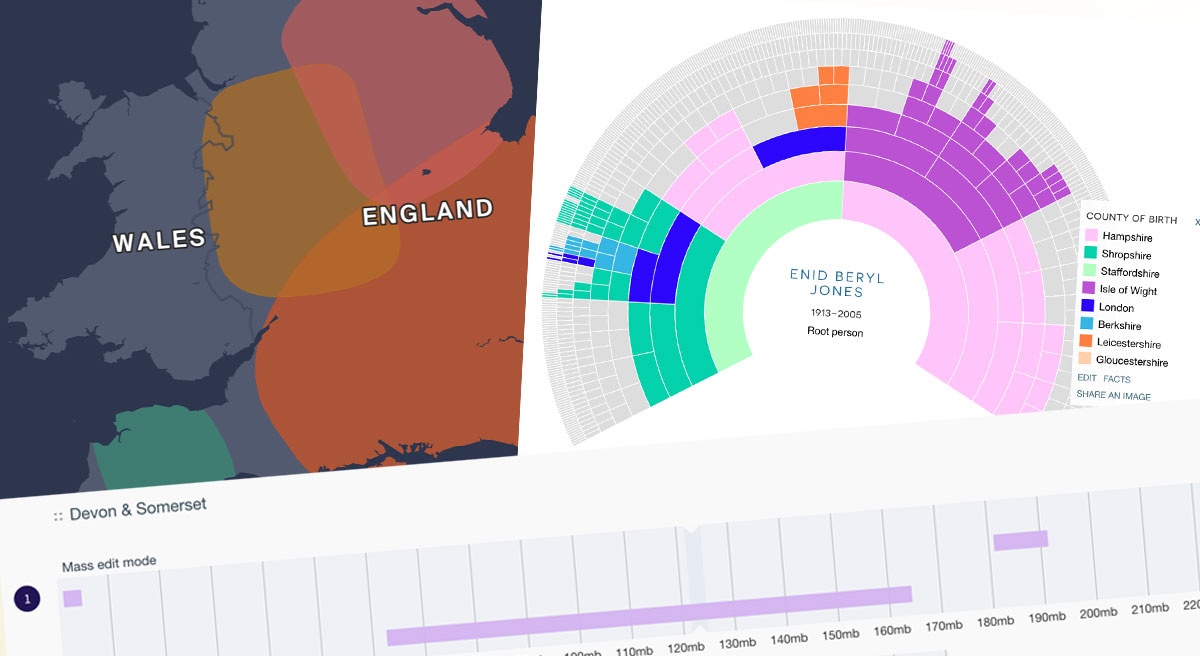
As you might have heard, AncestryDNA released a new regions update earlier this month. The most talked about feature is the ability to divide regions up by grandparent, but another key improvement is that the information in the chromosome painter is now much more refined.
First introduced in 2022, Ancestry’s chromosome painter is essentially your ancestral composition estimate expressed in segments. This followed similar longstanding functionality at 23andMe, which is also now available at FamilyTreeDNA. I’ve previously written about how to import these into DNA Painter, and my experience of mapping these segments.
To date, Ancestry’s population segments have been a bit strange. Many have reported that population assignments span the entire chromosome. I also observed this (with the notable exception of segments from my Jewish grandfather). I’m happy to report that this situation is much improved in the new release, as I’ll explore below.
Getting the segment data from Ancestry
As well as not providing the segment coordinates on the page, Ancestry have also made extracting them more difficult. Here are two ways to get them:
- My original ACPS tool allows you to copy the page, paste it in, and then generate a chromosome map or download a spreadsheet of segment values.
- The tool still works, but since Ancestry made changes in late 2025, it now involves putting a line of JavaScript into the console window
- This makes it too fiddly for all but the most technical users
- Kevin Borland has made a simple bookmarklet that lets you download a CSV of segments
- This works in the Chrome, Firefox and Safari browsers
- Once you’ve dragged this to your bookmarks bar, you can click on it to download the segment coordinates
- You can then import the resulting file, or paint the regions on a chromosome map individually by copying and pasting the relevant rows into the Paint a new match form
My updated segments
Experience tells me that Ancestry’s population segments will be refined further in future, but looking at them today, I do get that “it’s coming together” feeling, which wasn’t the case previously. I suspect everyone’s experience will be different and how helpful these segments can be for you may depend on your ancestral background.
My ancestral background
On my maternal side:
- Both my grandparents had similar typical Ulster Scots ancestry.
- This is now represented as a mix of Ulster, Ireland; Scottish Lowlands and Central Belt; and Northern England
- We have some recent documented Scottish ancestry on my mother’s maternal side, but unsurprisingly, this doesn’t seem to be genetically distinct from the other regions
- There seems to be a tiny bit of “bleed through” with a trace of East Midlands and Yorkshire that I suspect is actually from my father since it matches his ancestry and does not appear in my mother’s report
On my paternal side:
- My grandfather was a Jewish man from Germany, while my grandmother was English.
- My Ashkenazi Jews in Central & Southeastern Europe region from my grandfather remains distinct and matches the 26% proportion indicated by chromosome mapping
- The DNA I inherited from my English grandmother is represented by Southeastern England; West Midlands; and Devon and Somerset
- This is therefore potentially the part of the Regions estimate that could be the most helpful to me
Ancestry say that 17% of my DNA could not be assigned to a grandparent at the moment. While this is slightly disappointing, it’s far preferable to the alternative of them guessing!
Focusing on segments from my paternal grandmother
It feels as if it should be possible to distinguish between my grandmother’s maternal and paternal segments:
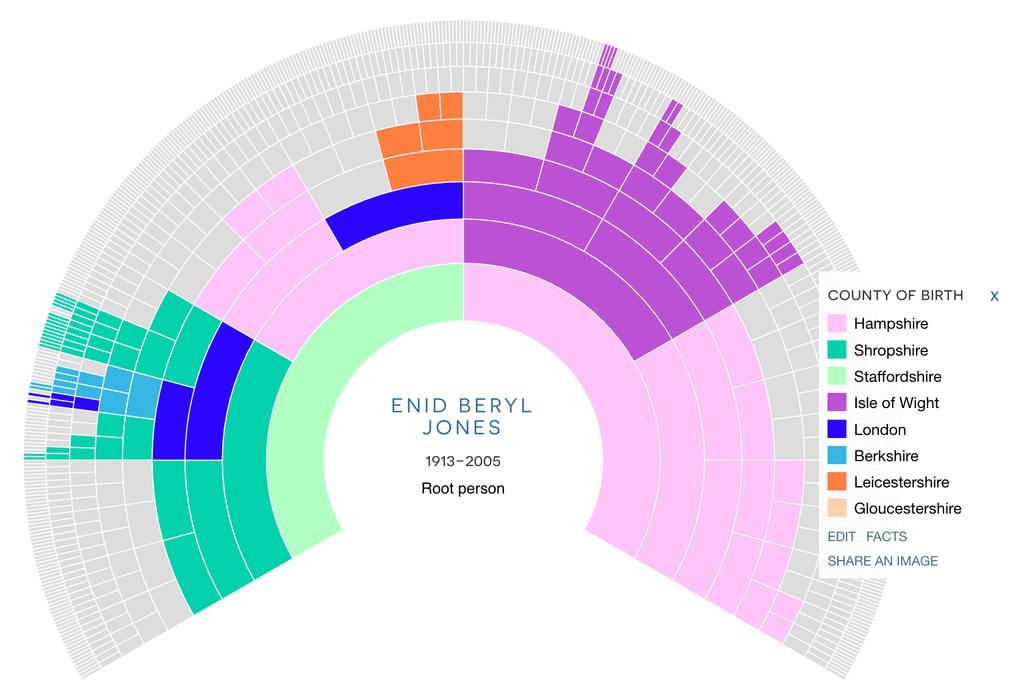
- My grandmother’s mother hailed from Hampshire and the Isle of Wight
- Her father has a more diverse English mix including Shropshire, the East Midlands and the North East, but also Hampshire (plus potentially some other places where my genealogy research has run dry)
I used the dimensions feature within my ancestral tree to visualize the English counties where my grandmother’s ancestors were born.
As I noted above, Ancestry currently breaks down the DNA I inherited from her as West Midlands; Southeastern England; and Devon and Somerset. Connecting this to the genealogy is obviously difficult:
- I don’t know which of her ancestors I received the most DNA from
- The regions are still quite broad
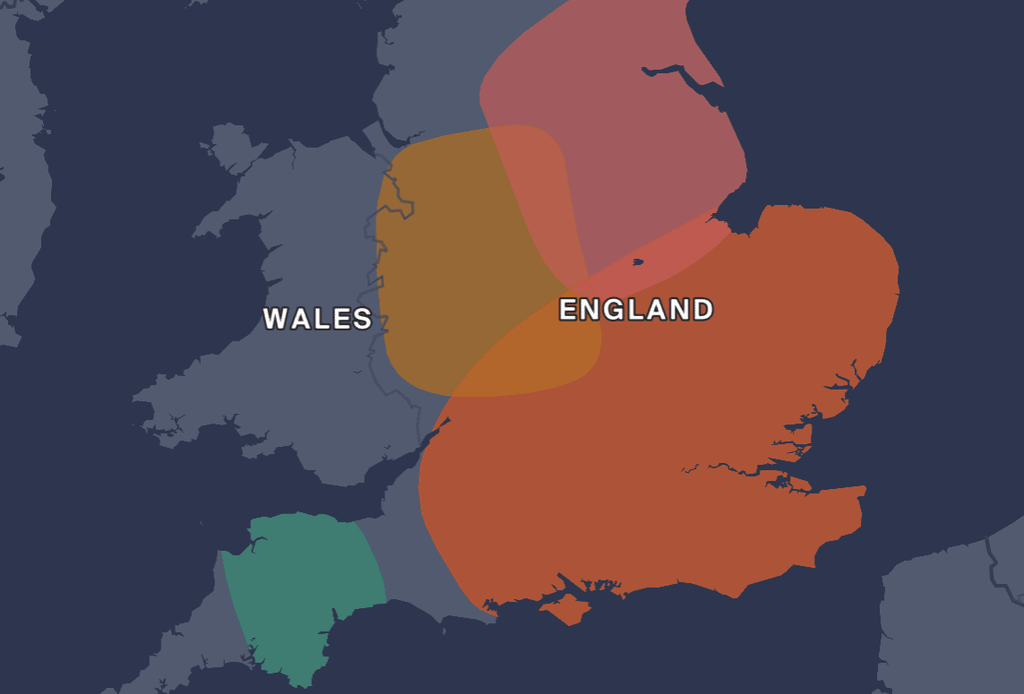
At first glance, I can see that West Midlands covers my known Shropshire Jones ancestry, while Southeastern England includes Hampshire but also Berkshire, Gloucestershire and London. I have no known Devon and Somerset ancestry, so I’m intrigued to see which branches these segments might represent.
Comparing to my existing chromosome map
Because I’m mainly interested in these three regions, I’ve mapped them in my existing chromosome map by copying the relevant lines from the CSV file into the Paint a new match form. Each population is in an appropriately named group, for example Ancestry Devon & Somerset. Here’s what I found from each:
Ancestry Devon & Somerset
There are 12 segments classified as Devon & Somerset.
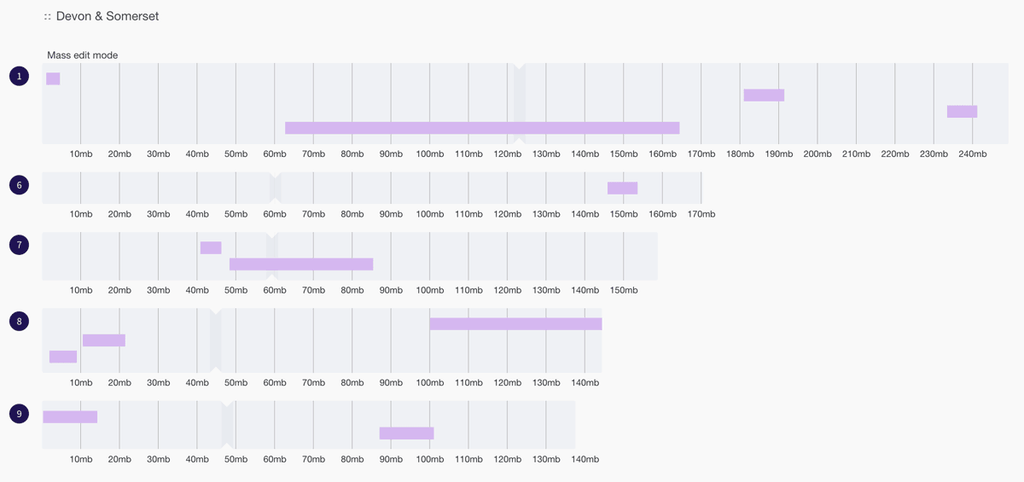
Interestingly, some of the assigned segments are very small. I used the batch feature of the cM estimator tool so that I could include the cMs for reference.
- Unfortunately, I don’t have many matches via my grandmother mapped
- Only two of these segments overlap with known matches, and these are both shared with a known Jones-Moore cousin
- If I had more matches overlapping these segments, I could probably speculate more usefully. For now, I’m just pondering brick wall ancestors:
- I wonder if my 4th-great-grandmother Mary Hodges could have hailed from Devon or Somerset
- Or perhaps my 4th-great-grandfather William Blackburn
- Being an optimist, I might go into the records for these counties to see if I find any candidates, but obviously I don’t have much to go on here!
- As if to hammer home this point, if I go back a generation and look at my father’s population segments, he has a Devon and Somerset segment. This completely overlaps one that I’ve assigned to the unknown parents of William Burbidge, born near Husbands Bosworth, Leicestershire (rather far from Devon or Somerset) in 1757!
Ancestry West Midlands
Looking at the areas for each region, I would expect these segments all to overlap only with segments from my grandmother’s Shropshire-born grandfather Charles Richard Jones.
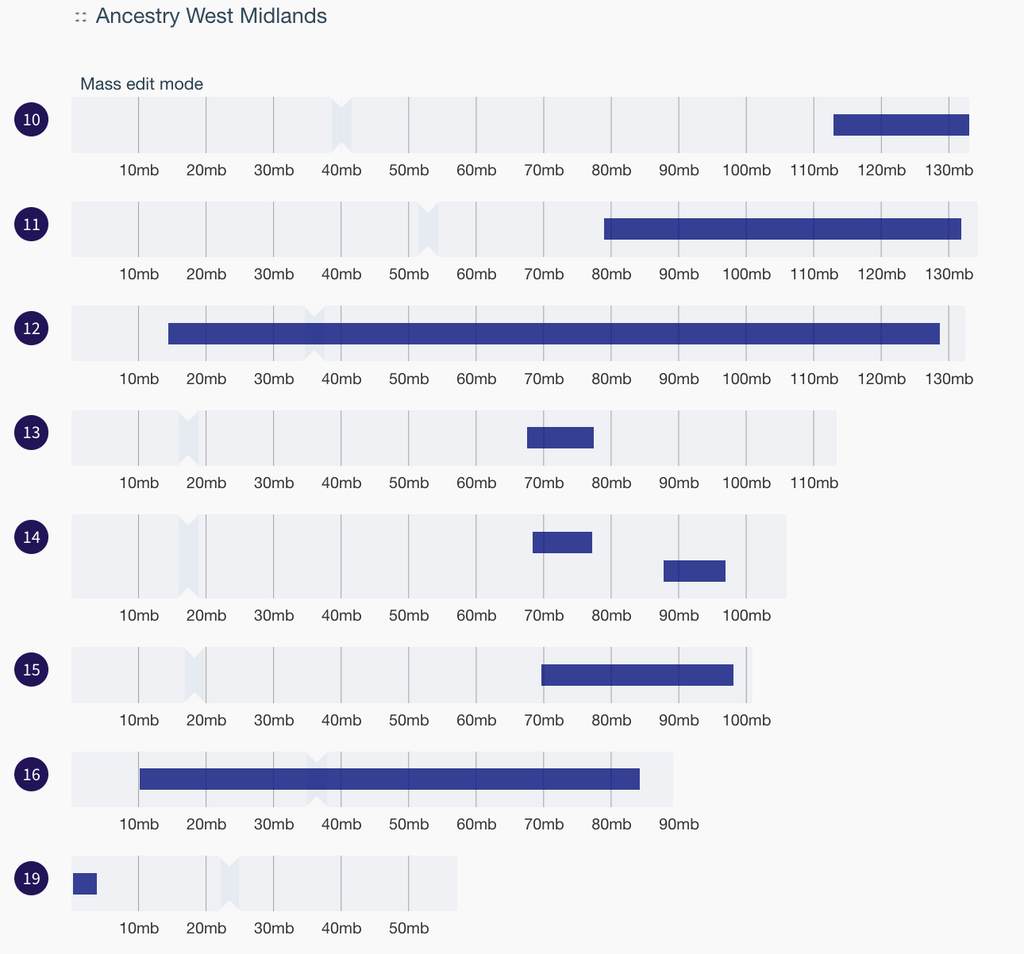
Again, my analysis suffers from a shortage of matches, but of the nine segments, four are indeed from Jones-Moore descendants. If the region is accurate, I can speculate that they originate from the largely Shropshire Jones side as opposed to the largely Hampshire Moore side. But of course, nothing is that simple: the Moore side also leads to Leicestershire, which could also be included in the West Midlands even though it’s slightly east of there.
But I am comfortable with speculating for now that all these segments are from the Jones-Moore side rather than the Hampshire/Isle of Wight Cooper side. While this is only really a potential clue in the absence of matching segments, it could be helpful when it comes to tentatively classifying unknown matches.
Ancestry Southeastern England
There are 23 segments mapped as Southeastern England. Because this region covers places associated with both of my grandmother’s parents, it’s harder to draw any conclusions.
To conclude
How has this helped me overall? It has taken me on an interesting journey into my English segments and suggested a couple of potential research paths. Has it helped me identify ancestral lines? Not really, but I anticipate that future releases will have the potential to help more.
So that’s my experience. I hope these new regions have been interesting and helpful for you too.
Contact info: @dnapainter.bsky.social / jonny@dnapainter.com