
Back in 2021, I wrote an opinion piece describing features I felt could improve each of the DNA testing sites. More than five years have now passed, so I thought I’d revisit to see what has changed.
Alas, a lot of the changes since 2021 have not been positive for those who like to use segment data. However, an unexpected development is the new offering of low pass whole genome sequencing tests at FamilyTreeDNA and MyHeritage. Ancestral composition estimates continue to attract attention and happily are also generally more accurate than they used to be.
I’ve become acutely aware recently that only 23andMe, FamilyTreeDNA and Gedmatch give you access to X-DNA information. Given the extremely powerful nature of the X-DNA inheritance path, and since all autosomal tests include X-DNA, this feels very frustrating!
At the end, I’ll give a shoutout to a browser plugin that can add functionality to improve your experience across testing sites.
What’s the strongest match I haven’t investigated?
As I wrote in 2021:
When I log into a testing platform, the first thing I want to do is very simple:
- See a list of any unviewed matches, with those that I share the most DNA with at the top
As we approach the end of 2026, I still can’t do this on most sites.
This feature is a combination of “sort by DNA shared” and an Unviewed filter. AncestryDNA has this, but the other sites all just have “Sort by newest”. This makes it much more likely that the user will miss a useful match:
- While those who share a lot of DNA will appear at the top in the regular ‘by DNA Shared’ view, other medium sized matches might slip by unnoticed

The site where this feature is most missed is MyHeritage, where I still get lots of new matches. With no way to combine an Unviewed filter with the regular ‘sort by DNA shared descending,’ it’s quite easy to miss matches in the 30-70cM range who could potentially be very useful.
Living DNA
While their database is very small compared with the major platforms, as I said in 2021:
This British-based company has what feels like a very fresh userbase, with many matches who are not other testing sites. The match list also features a very useful snapshot of how active the user is, which can be used to gauge how worthwhile it might be to contact them.
In 2023, Living DNA answered my prayers and launched a chromosome browser. Not only this, but they also now include a handy copy segment data button that lets the user copy the data to their device’s clipboard. It seems odd that segments down to 3cM are included by default, but there’s a checkbox allowing you to exclude this. This makes Living DNA a potentially useful platform for those of us who are mapping our chromosomes.
There have been a few other updates since 2021:
| My 2021 Living DNA wishlist | 2026 situation |
| Include number of segments | This information is now available |
| Include a simple form field allowing users to reveal genealogical info | This still doesn’t exist, somewhat limiting the usefulness of the platform! |
| Adjust the order of shared matches so closer matches are first | They fixed this so that closer matches are now at the top |
| Segment data for matches | This is now available! |
| Segment data for ancestry composition | Still not provided; this would be interesting to see. |
If you look closely, you will realize that the main match list is unfortunately not entirely what it seems. The cM totals used for each match include 3 to 7cM segments, many of which are likely to be false. For example, I have a match shown as 25cM, but when I click into the Shared DNA tab and check the box ‘Only show segments larger than 7cM’, I see the match is only 12cM.
My top Living DNA requests going forward:
- Add a simple text field to each test allowing users to enter last names and ancestral town information, and display this to matches
- Remove segments of under 7cM from the shared cM calculation used for the match list
- ‘Matches of matches’: an indication of how much DNA shared matches share with that match you’re looking at
- Provide segments corresponding to the ancestral composition estimate
- A bulk download of segment data for all matches*
* The Genealogy Assistant browser plugin (see below) allows you to do this
FamilyTreeDNA
As I noted in 2021
A pioneer of direct-to-consumer DNA testing, FamilyTreeDNA was founded more than 20 years ago and offers Y and mitochondrial tests as well as autosomal.
Recent updates
- FTDNA briefly removed their bulk CSV of segments, but restored it in 2024
- FTDNA now sometimes provides top-level Y haplogroup to autosomal testers, with a top level mito haplogroup coming in future.
- You can now download segments for ancestry composition data
- New tests use Next Generation Sequencing, with an upgrade available to existing testers for $29
The main benefits of the site remain as they were:
Their database isn’t the largest, but the site has some great features:
- Matches can add trees and lists of last names
- You can obtain segment data for each match and export all your data into spreadsheet format
- It’s possible to transfer tests from other companies
Perhaps their most powerful feature is the ability to ‘bucket’ matches once you’ve identified close testers in your tree. For example, if you have a paternal cousin tested and you indicate this at FTDNA, other matches who share the same DNA will be labelled as paternal.
Here are the updates since 2021:
| My 2021 FTDNA wishlist | 2026 situation |
| Remove tiny segments | They’re gone! |
| On-site clustering tool | We still don’t have this, and it would be nice. Clustering can be done via third-party tools Genetic Affairs and DNAGedcom. |
| Handling endogamy better | This remains a bit of a blind spot for all the DNA platforms |
Another new development at FamilyTreeDNA that might have gone under most people’s radar is that in the revamped matrix tool, you can now see how much DNA your selected matches share with each other. This means that this often-crucial information is now available at all the main platforms other than Living DNA.
MyHeritage
It remains the case that MyHeritage has a large database and some great features. There have been a couple of dramatic changes since 2021:
- After the 23andMe data breach, MyHeritage removed its bulk segment data download and has not restored it
- At the end of 2025, MyHeritage announced that all new autosomal DNA tests would be processed with low-pass whole genome sequencing
- In 2026, MyHeritage removed the ability to transfer in DNA tests from other vendors
The end of transfers is unfortunate in cases where a tester is not able to provide a new sample, but on the plus side, tests are now cheaper than ever. I have taken a fresh test in order to benefit from their new low pass whole genome sequencing but so far this hasn’t had an impact on my research. I note that they are also rolling out a 30x WGS test, apparently aimed at the health and wellness market.
MyHeritage have just introduced the ability to confirm relationships, and have released new features quite consistently, including showing broad Y-DNA haplogroup reports to male testers.
Other updates since 2021:
| My 2021 MyHeritage wishlist | 2026 situation |
| Filter for unviewed matches | We still don’t have this but desperately need it! |
| A segment length threshold for shared segments | Perhaps this request was a bit optimistic, but in general there still seems to be an issue with some of the smaller segments at MyHeritage. Hopefully this will be addressed in the DNA accuracy project announced earlier this year. |
23andMe
A lot has changed at 23andMe since 2021. After filing for bankruptcy in 2025, the company is now owned by TTAM Research Institute, led by former CEO Anne Wojcicki.
- The site endured a credential stuffing attack in 2023 and removed all segment data in the aftermath
- Until January of 2026, the site remained in this state of heavily reduced functionality
- They then announced that segment data was back, but only for those who subscribe to their 23andMe+ premium membership
- It’s also worth noting that this membership is payable *per kit*, unlike comparable products at AncestryDNA and MyHeritage
- However, they sweetened this considerably by introducing the very useful and customizable DNA Relative Clustering tool
The site still features their innovative dna family tree. In late 2025, 23andMe also announced a new reconstructed ancestors feature as part of the 23andMe+ membership.
23andMe also introduced their New HybridIBD algorithm in late 2024. This didn’t have quite the impact on my predicted relationships that I’d hoped for.
Here are the wishlist updates since 2021:
| My 2021 23andMe wishlist | 2026 situation |
| Filter for unviewed matches | There is a now a feature that claims to let you “select DNA Relatives who have been added to your list since the last time you logged in” but it has always shown zero for all my tests. |
| A more flexible cap on matches | As before, you can pay extra to get up to 5,000 matches |
| Reduce the number of steps required to find segment data | Even for those who subscribe to receive this data, the process remains slightly cumbersome |
AncestryDNA
AncestryDNA have been busy since 2021, refining their interface and adding plenty of new features. There’s still one notable feature missing, but life would be boring if we got everything we wanted. (Yes, I’m talking about segment data!)
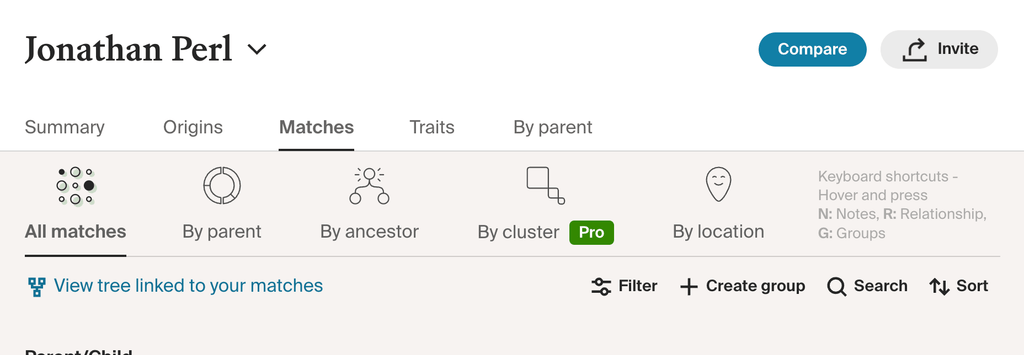
The showstopper has been “matches of matches“, part of the paid Pro Tools add-on that allows you to see how much DNA your matches share with each other. One benefit of this powerful feature is that you often have additional ways to puzzle out DNA matches even if they don’t themselves have a tree. Ironically, it’s a feature that already existed elsewhere, but the size of AncestryDNA’s database has magnified its impact.
Another very welcome development the fact that their recent Regions Update appears to have carried through to their chromosome painter feature, meaning we no longer have obviously erroneous ‘whole chromosome’ segments for different populations.
Here are the updates since 2021:
| My 2021 AncestryDNA wishlist | 2026 situation |
| Segment data opt-in | Alas, this has not come to pass |
| The option to lower the shared match threshold | The threshold remains 20cM. Maybe it’s for the best! |
| Increased reliability | The situation is much better than it was, but the number of ‘This page is unavailable’ occurrences is still not really acceptable |
Possible improvements that apply to all sites
This is the part where I tried in 2021 to come up with some new ideas. Do I have any more? Let’s see!
Modifiable clusters
I find the potential of clustering my matches intoxicating, but in practice I do find automated clusters a bit cumbersome to work with (much as I appreciate having them):
- The people I’m most excited about identifying are the descendants of potential siblings of my brick wall ancestors
- At the moment I will make a note or apply a coloured label to anyone where I’ve identified the common ancestors
- This allows me to focus on the unidentified people who might connect via one of these siblings and who might therefore help me identify the unknown parents.
- However, I feel there could be an easier process built in
- Surely if I can tell the sites who the known common ancestors are for each match, the cluster display could then signpost the not-yet-identified matches more clearly
- Perhaps it could even suggest links between them where the trees exist?
Taking better account of endogamy
To repeat what I said in 2021: the testing companies know that I am around 25% Ashkenazi Jewish. They also know that a Jewish match of 43cM over 5 segments is unlikely to be a 3rd-5th cousin. It would therefore be great if this could be taken into account:
- In the first instance the notification email could include the number of segments
- Ultimately perhaps the sites could downgrade the relationship estimate somehow. This currently happens to a degree at 23andme and at Ancestry (via their Timber algorithm), but it feels as if more refinement would be possible.
Genealogy assistant
I can’t finish this article without giving a shout-out to Dan Maloney’s Genealogy assistant browser extension. This works in Chrome, Firefox, Edge and Safari, and ingeniously adds a lot of missing functionality from the major genealogy platforms. The extension is preposterously useful, and I say that having probably only just scratched the surface of what it can do. There’s a 30-day free trial and the cost is then US$3.95 per month, US$39.95 per year, or a one-time payment of US$59.95. I am not associated with this tool in any way but can recommend it very highly.
Here’s to 2031
It’s slightly mind-boggling to imagine what might be possible once a further five years have passed, but I look forward to reporting back on things then. In the meantime, I hope this has been useful! I’ll be back with a recent case study showing the degree to which X-DNA has helped me (thank you Gedmatch!)
Contact info: @dnapainter.bsky.social / jonny@dnapainter.com